United Nations Chronicle Korea
2024
Climate Action for Sustainable Economy
A student-led green growth initiative that connects climate action with sustainable economic development. Through hands-on activities in green consumption, sustainable finance, climate entrepreneurship, and low-carbon behavior, the project helps high school students understand how individuals, businesses, and governments can contribute to an inclusive green economy.

Overview
Turning Climate Action into a Hands-On Green Growth Experience for Students
CASE is a student-led green growth project that translates sustainable economic development into practical, everyday action. Through activities focused on green consumption, sustainable investment, climate finance, and green entrepreneurship, high school students explored how individuals, businesses, and governments can contribute to a low-carbon economy. Participants analyzed corporate sustainability performance, practiced environmentally responsible consumption, quantified carbon reductions, and designed climate-focused business ideas.

The Impact
The project moved climate education beyond classroom-based awareness by connecting environmental action with measurable economic incentives. Its Green Cash system converted students’ low-carbon activities into rewards, while collaborative campaigns and an eco-friendly festival booth encouraged wider participation across the school community. By integrating climate action, financial literacy, and entrepreneurship, CASE demonstrated a replicable model for engaging young people in inclusive green growth and was presented as an SDG 8 good practice at the UN ESCAP forum.
1 - Green Investing and Green Consuming
Turning Climate Knowledge into Investment and Consumption Decisions
To make climate finance and climate technology more accessible, the team developed SONAGI Magazine, a three-volume educational series built around fictional companies and evolving business news. Each issue introduced topics such as biodegradable materials, sustainable food production, renewable energy, secondary batteries, ESG management, and green finance through realistic corporate decisions and market events.
The three volumes functioned as sequential rounds of a mock stock market. Students analyzed each article, identified positive and negative environmental and financial signals, and created or revised their investment portfolios. As new information emerged—from climate-tech partnerships and RE100 commitments to green bonds, product controversies, and battery-safety incidents—students had to reassess each company’s risks, credibility, and long-term value.
Rather than teaching climate concepts as isolated definitions, the magazines placed students in the role of investors. This activity helped them understand how climate technology affects business performance, how finance can accelerate the green transition, and why environmental impact and ESG risk should be considered alongside short-term profitability.
Article Analysis

Mock Investment

Green Living Practices

2 - Operating a Green Festival Booth
Turning Sustainable Business Ideas into a Student-Led Green Festival Booth
SDGs BM Canvas

Green Cash Campaign

Collaborating with Trash busters

Outcome
Translating Climate Education into Measurable Green Growth Outcomes
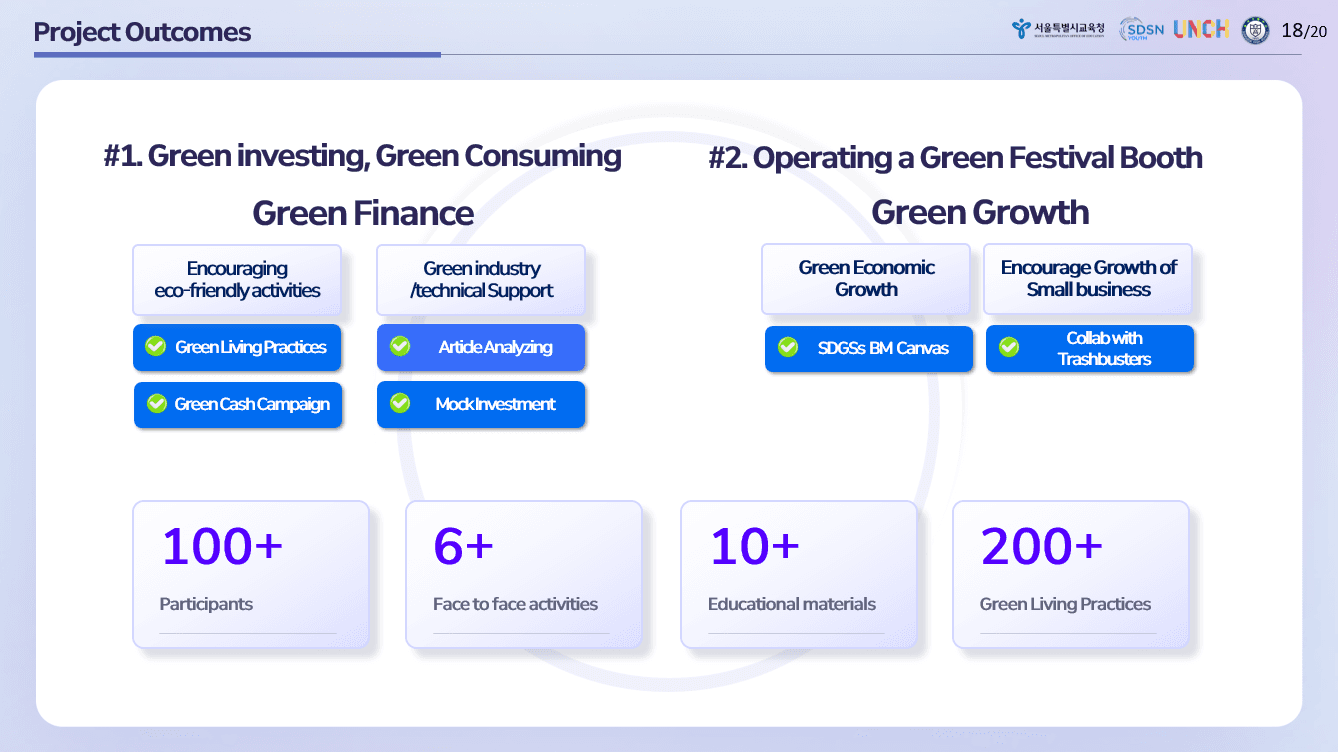
CASE transformed climate finance and green growth concepts into measurable participation, learning, and behavioral outcomes. Across two integrated tracks—Green Investing and Green Consuming and Operating a Green Festival Booth—participants engaged in article analysis, mock investment, green consumption, sustainable business-model design, the Green Cash campaign, and collaboration with a reusable-container company.
The project engaged 100+ participants through more than 6 face-to-face activities, produced 10+ educational materials, and documented over 200 green living practices. These outcomes demonstrate how student-led climate education can move beyond awareness by influencing investment thinking, consumption choices, sustainable entrepreneurship, and repeated low-carbon action.
Lessons
Designing for repeated participation, not one-time climate awareness
This project reinforced that climate education becomes meaningful only when students can connect abstract concepts with real economic decisions. Topics such as climate finance, ESG, green technology, and sustainable consumption were easier to understand when students analyzed companies, allocated mock investments, designed business models, and made purchasing decisions themselves.
A second lesson was that effective learning requires progression. The three-volume magazine series introduced new corporate developments over time, prompting students to reassess earlier judgments rather than complete a single, isolated task. This sequential structure helped students understand that sustainability performance and investment risk must be evaluated continuously as new evidence emerges.
The project also showed that incentives can encourage participation, but they should remain connected to measurable environmental behavior. Green Cash was effective because rewards were tied to documented low-carbon actions and could be used within the festival booth, creating a visible link between individual behavior, economic value, and collective climate impact.
Finally, implementation required collaboration beyond the classroom. Developing the festival booth, operating the campaign, and working with Trash busters demonstrated that green growth depends on coordination among consumers, businesses, educators, and institutions. Combining education with real operational constraints made the program more credible, practical, and replicable.


