Connect Lab
2026
ODAI: ODA Consortium Matching Platform
ODAI is a public data–driven platform that analyzes ODA tenders, verifies organizational capabilities, and recommends role-based consortium partners. It combines LLM-powered document analysis with procurement data to make consortium building faster, more transparent, and evidence-based.

Overview
ODA Consortium Matching Platform
ODAI helps organizations identify suitable ODA opportunities, assess their capabilities, and find potential consortium partners. It combines public procurement data with LLM-based tender analysis to structure project requirements and recommend partners based on verified experience, sector expertise, and role fit.
The Impact
The redesign focused on improving clarity across the dashboard through better hierarchy, cleaner spacing, and more visible transaction details. The updated experience made everyday financial workflows easier to scan and navigate while introducing lightweight interactions that surfaced more context when needed.
Problem
Building ODA consortiums still relied on fragmented data and personal networks
Organizations preparing ODA proposals had to search across multiple procurement and institutional databases, manually review tender documents, and verify potential partners one by one. Because the relevant data was scattered and inconsistently structured, partner discovery was time-consuming, difficult to validate, and often favored organizations with established networks over smaller or newer participants.

Research
Mapping the real barriers behind ODA consortium building
To understand where friction occurred, I mapped the end-to-end consortium-building process and reviewed the public data sources used by ODA practitioners, including KOICA, KONEPS, MOIS, and DART. The research focused on how organizations discover tenders, interpret project requirements, verify institutional experience, identify capability gaps, and search for suitable partners across fragmented systems.
The findings revealed three recurring barriers: dispersed and inconsistent data, repetitive manual verification, and partner discovery shaped by existing networks rather than demonstrated capability. These insights informed the platform’s core structure—integrated institutional profiles, component-level tender analysis, evidence-based fit scoring, and role-specific partner recommendations.
What we learned
Through workflow analysis and interviews with ODA practitioners, I identified recurring patterns in how organizations searched for tenders, reviewed project requirements, verified institutional experience, and identified consortium partners. The biggest issue was not a lack of available information—it was fragmentation. Users had to move across multiple public platforms, manually compare inconsistent records, and rely on personal networks before making partnership decisions.
This process made it difficult to assess organizational capabilities objectively, identify missing expertise, and discover qualified but less-connected partners. The research showed that consortium formation needed a more integrated workflow that connects tender analysis, verified performance data, capability-gap assessment, and role-based partner recommendations.
Data Architecture
Structuring the data behind consortium recommendations
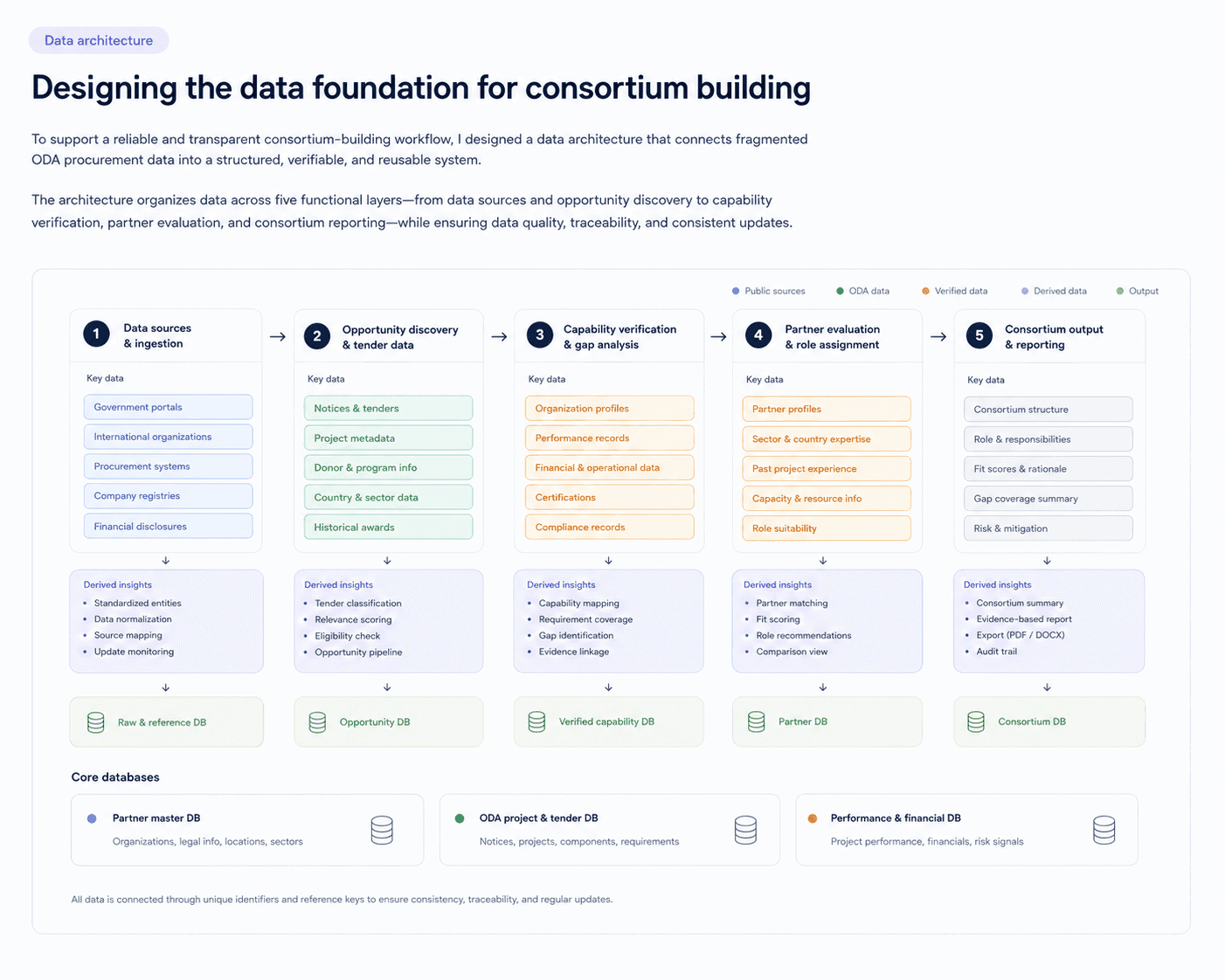
Based on the research findings, I translated the consortium-building workflow into a structured data architecture. The system connects organization profiles, ODA projects and tenders, and procurement records so that each recommendation can be traced back to verified evidence.
The architecture was designed around five stages: organization registration, opportunity matching, tender component analysis, capability-gap assessment, and consortium report generation. This structure clarified how raw public data, institutional capability profiles, and LLM-based document analysis could work together as a single decision-support pipeline.
Development
Turning the consortium workflow into a working platform
The final platform translated the research and ideation findings into a structured end-to-end workflow. Each screen was designed to help organizations move from institutional setup and opportunity discovery to capability analysis, partner selection, and consortium report generation with clearer evidence and fewer manual steps.
Organization Onboarding
Users begin by selecting an existing organization or registering a new one. The platform creates a verified institutional profile by connecting public data on legal status, location, capabilities, and past performance.
Opportunity discovery
The dashboard recommends ODA opportunities based on the organization’s country experience, sector expertise, and implementation history. Fit scores and capability gaps help users quickly identify which tenders are worth reviewing.
Component and capability analysis
The platform breaks each tender into core requirements and evaluates which components the lead organization can cover directly. Missing capabilities are clearly identified, helping users understand where external partners are required.
Partner directory
Potential consortium partners are ranked by role fit, sector expertise, geographic experience, and verified project records. Users can compare organizations side by side and add suitable candidates directly to the consortium.
Consortium report
The final report consolidates the recommended partner structure, role allocation, evidence, capability coverage, and implementation risks. Users can review the proposed consortium and export the report in PDF or DOCX format.
Lessons
Designing for transparency, evidence, and inclusive participation
This project reinforced that the main challenge in ODA consortium building is not a lack of information, but the difficulty of turning fragmented data into confident decisions. Throughout the process, I explored how structured tender analysis, visible capability gaps, and evidence-based partner recommendations could reduce uncertainty and manual effort.
One of the key lessons was that transparency must be built into every recommendation. Fit scores alone are not enough—users also need to understand why an organization was recommended, which requirements it can cover, and where additional expertise is still needed. The project also showed how better access to verified information can make consortium formation more inclusive for smaller and less-connected organizations.


